
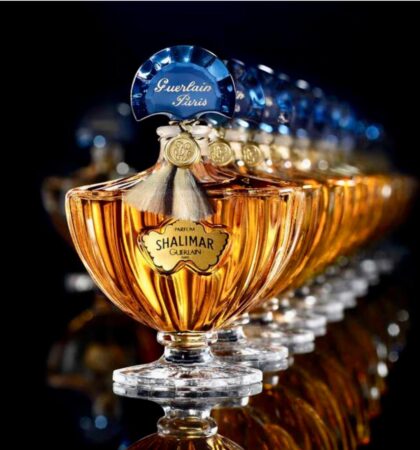
Guerlain Shalimar courtesy of Guerlain
I seem to have loved you in numberless forms, numberless times…
In life after life, in age after age, forever.
My spellbound heart has made and remade the necklace of songs,
That you take as a gift, wear round your neck in your many forms,
In life after life, in age after age, forever. ~ excerpt from Unending Love by Nobel Prize-winning Indian poet Rabindranath Tagore
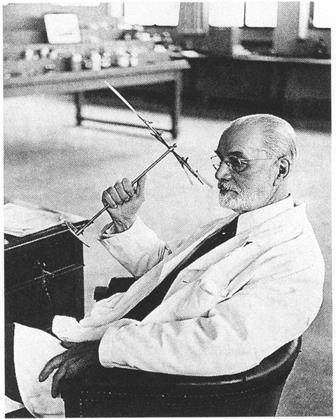
Jacques Guerlain 1912 courtesy of Fragrances of The World
Everyone loves a love story; how could they not? 2025 marks the 100th anniversary of master perfumer Jacques Guerlain’s much-lauded parfum Shalimar – and Shalimar is all about unending love and one of the greatest love stories ever told. It is arguably one of the first fragrances which spring to mind whenever the name Guerlain is uttered – and that’s not surprising, because the perfume has retained its popular status for an entire century.
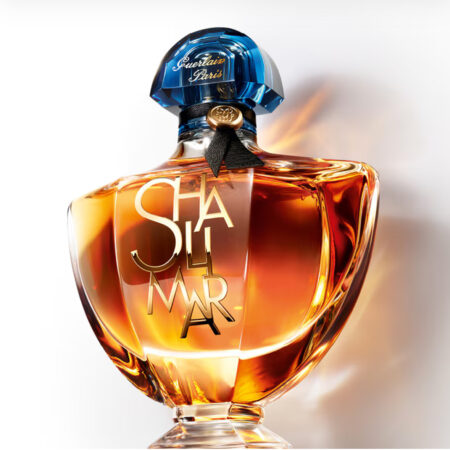
Shalimar L’Essence created to celebrate the Centennial by perfumer Delphine Jelk via Guerlain
True, Guerlain’s Grande Dame has weathered many iterations over the years and has received more face lifts than the vainest film star – but she’s still with us, swanning about in whichever form one chooses to favor. The public’s tastes change over the years; certain olfactory materials become either unavailable or unacceptable. The Perfume Greats (such as CHANEL No.5 and Shalimar) are sometimes referred to as ‘old lady perfume’ – a term I abhorred long before I actually qualified as one (frankly, I never understood the bias). They are magnificent resinous, “ambery” (the term used by Guerlain to describe Shalimar) creations. When you view this era with an historical eye, there was a fascination with the East which captured the imaginations of painters, poets, designers, and perfumers (here we cite Paul Poiret, John Singer Sargent, Charles Baudelaire, Victor Hugo, et al). Thus, a new demand evolved for these exotic, narcotic scents redolent with spices, balms, and animalics from far-off lands.
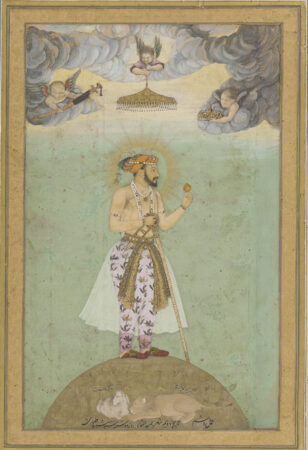
Shah Jahan via Wikipedia mid-17th century
“Remember one thing,” Jacques Guerlain told his perfumer grandson Jean-Paul. “One always creates perfumes for the woman with whom one lives and whom one loves.”
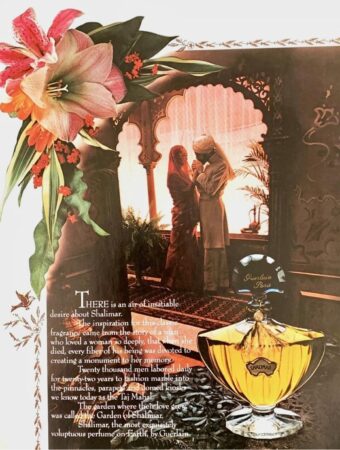
vintage Shalimar ad 1980 courtesy of Guerlain
The name Shalimar translates as ‘Temple of Love’ from the Sanskrit, and it comes by this appellation honestly: Shalimar is an olfactory homage to the famous Mughal Shalimar Gardens of Lahore and Shah Jahan’s undying devotion to his empress consort Mumtaz Mahal. Mumtaz was so adored by her husband (who was expected to have multiple wives) that the name by which we recognize her was actually bestowed by him: The Exalted One of the Palace. While the fifth Mughal emperor Shah Jahan dutifully had one child with each of his wives, he and Mumtaz had fourteen offspring together over their nineteen-year marriage, and he loved her to the exclusion of all others. When she died in childbirth with their fourteenth child, Jahan was inconsolable.

Taj Mahal via Unsplash
He later built an immense white marble mausoleum we know as the Taj Mahal – considered one of the seven wonders of the world – to honor and immortalize his wife for all time.
“Guerlain for the courtesan, and Caron for the queen” ~ famous anonymous quote, no attribution available
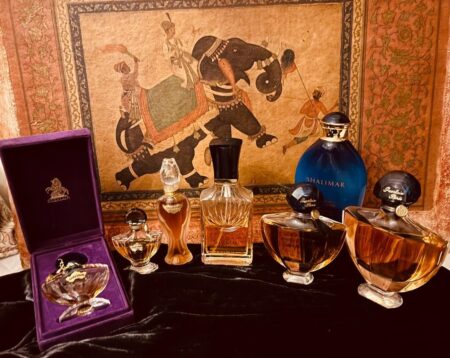
Ida’s Shalimar collection©
I include the above quote because there are more recent generations who may likely be unfamiliar with it. Many years ago, Caron was regarded as fine fragrance for the privileged and titled – and Guerlain’s very voluptuous perfumes were considered more than a bit scandalous. Jacques Guerlain has gifted us with an immense roster of unforgettable scents; Shalimar is immortal, and there are many others: Jicky (1889), Mouchoir de Monsieur (1904), Après L’Ondée (1906), Muguet (1908), L’Heure Bleue (1912), Mitsouko (1919), Guerlinade (1924), Djedi (1926), Líu (1929), Vol de Nuit (1933), and Sous le Vent (1934) amongst them (and there are many more!). As the most prolific perfumer for the house of Guerlain, we owe Jacques Guerlain a significant debt of gratitude.
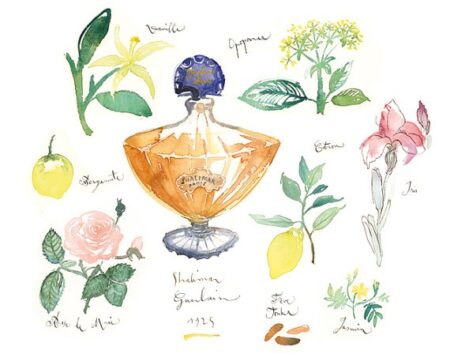
Illustration of Guerlain Shalimar and ingredients used with permission by Lucile Prache
When we discuss Shalimar, we do well to include the concept of the Guerlinade – an aromatic signature long associated with a memorable accord. It has been a leitmotif running through the fabric of many Guerlain fragrances. Originally, the Guerlainade was composed of six primary essences: vanilla, bergamot, tonka bean, iris, rose, and jasmine. Today we find many variations on this theme which echo its pastry-like sweetness. Word of mouth suggests that Jacques Guerlain emptied a sample of ethylvanillin provided by his colleague Justin Dupont (of Dupont Roure fame) into a flacon of his uncle Aimé’s beloved Jicky (1889), which resulted in the brainchild bone structure for Shalimar. The perfume took four years to complete (1917-1921), and Jacques Guerlain was forced to rename his fragrance as “No.90”, due to legal issues which were later resolved. The presentation of legendary Shalimar at the International Exposition of Modern Industrial and Decorative Arts in 1925 (Pierre Guerlain, Jacques’ brother – was vice president at the time) marked its rapid ascent to renown and popularity. We have been besotted with Grande Dame Shalimar ever since, regardless of how she appears today – more balsamic, sweeter, less animalic, less floral (in general), less spicy.
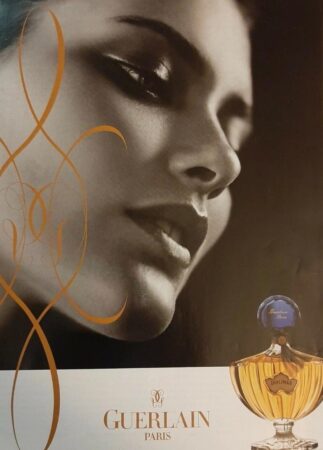
1998 ad via Guerlain
Those who recall the Shalimar of even the 1960s-1980s might not immediately recognize her current transformation, but today’s audience still retains a fondness for the fragrance with which they are acquainted. Nothing in life remains the same, and change is practically the watchword of our faith. Many perfume aficionados find modernized iterations of the great lady easier to wear – and she remains a staple of the fragrance wardrobe. However you choose to celebrate her beauty, Guerlain Shalimar shows no signs of relinquishing her crown. Long may she reign.
Notes: bergamot, lemon, mandarin, rosemary, iris, jasmine, rose, patchouli, vetiver, vanillin, opoponax, tonka bean, frankincense, sandalwood, musk, civet, ambergris, leather, coumarin, Peru balsam
My review is based upon multiple bottles from my vintage collection. My nose is my own.
~ Ida Meister, Deputy and Natural Perfumery Editor
Fragrance Vault carries many versions of vintage Guerlain Shalimar from over the years to sample.
Follow us on Instagram @cafleurebonofficial @idameister
This is our Privacy Policy