
I love fairytales. As I grow older, I find myself loving them even more, as I find new layers and meanings that can be peeled away to reveal hidden facets of universal truths. One of the most prominent figures and the one who validated this field as a serious subject of research, was a Romanian, Mircea Eliade, widely regarded as the most influential historian of religions of the modern era. Growing up in Romania, my formative years overlapped with the fall of the dictatorship and the profound shifts that it brought, reshaping every aspect of society. As the old world collapsed, a collective thirst emerged for the knowledge and the sense of the sacred that had been suppressed for decades. My older brother was a passionate history of religions and mythology buff, so, from a very early age. I trace my fondness for India and its mythos, history, and rich cultural tapestry back to my brother. India is the perfect example of how myth, ritual, and daily life weave together into one inseparable fabric, where the sacred exists not apart from existence, but is interlaced with every gesture. This is why I felt such an immediate connection to the brand Śasva.
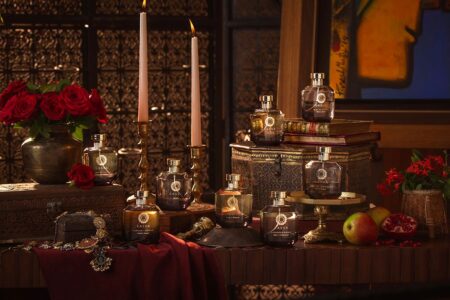
From the first encounter, I found in their narrative the same understanding I have of the magical art of perfumery, of how scent and memory can converge into one singular experience. Śasva carries within its very name the Sanskrit symbol of excellence for the praiseworthy, the laudable. There is something so deeply intentional and beautiful about this choice, as the founder, Sriman Subramanian, understood that a fragrance house exploring the depths of Indian spirituality must first honor the language that gave birth to some of humanity’s most profound philosophical insights. Their logo, depicting a thousand-petal lotus, speaks to the same reverence for symbolic depth, and in Indian tradition, the sahasrara, the crown chakra represented by the lotus, symbolizes supreme consciousness, the universal spirit that connects all beings and transcends the individual.
“Come, fill the Cup, and in the Fire of Spring / The Winter Garment of Repentance fling: The Bird of Time has but a little way / To fly – and Lo! the Bird is on the Wing.” – Rubáiyát of Omar Khayyám
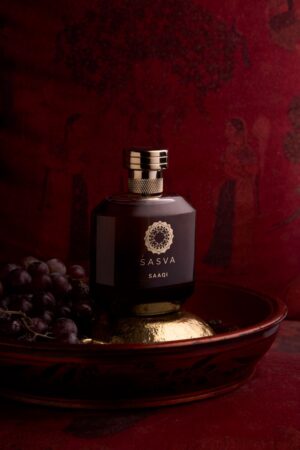
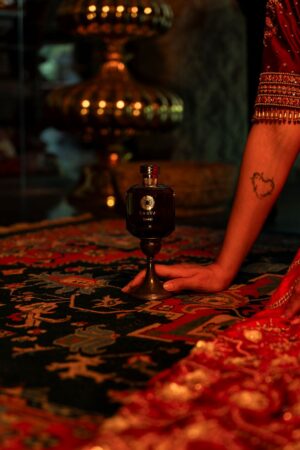
What captivated me about Śasva’s collection is the way each fragrance becomes a threshold into India’s rich and varied emotional landscape, from the echoes of dawn prayers brushing against ancient temple corridors, to the electricity of Bombay after dark, to the shimmering silver aura of a moonlit night, spent on a beach in Goa. Past and present, sanctity and carnality, love and divinity all merge into a sensorial world. One that is built on liminal states and chiaroscuro contrasts, for a result that is atmospheric, rich and opulent. I was won over by Saaqi: my guide into a journey that took me to a lantern-lit tavern along the Silk Road, there where India meets Persia, and wine flows like poetry. Soft voices whisper with the verses of Khayyam, Hafez or Rumi, and pour into our souls a taste of both what is deeply humane and the promise of the divine. The Saaqui is the mystical Sufi wine bearer who brings not just the ruby potion to our lips, but opens a passage to eternity. He holds the keys to enlightenment and fills up the cup for those brave enough to take the leap of faith.
“Come, fill the Cup, and in the Fire of Spring / The Winter Garment of Repentance fling:
The Bird of Time has but a little way / To fly – and Lo! the Bird is on the Wing.” – Rubáiyát of Omar Khayyám
Śasva Saaqi opens with a ruby splash of fruity wine, accompanied by the bitterness of almond and the sparkle of black pepper, a heady prelude that intoxicates the senses just before it ignites them. Sweet, dark, scarlet red, it inebriates and seduces while ripe fruits swirl around the crimson lights of the tavern, as the first flickers begin to dance in the shadows. The cup we are offered becomes a vessel of paradox: both fleeting pleasure and eternal truth, and we have here exactly this beautiful tension – the intoxication of the senses as an initiation into something deeper, where carnal desire and transcendence flow from the same chalice. The heart beats in smoky rhythm, as honeyed tobacco curls like incense through the air, colliding with cedarwood pillars that hold up the vaulted tavern, a new gravity drawn between each breath. Embers of smoke blur the line between ritual and temptation until they dissolve.

“Through love all that is bitter will sweet / Through Love all that is copper will be gold.” – Rumi
Śasva Saaqi stirred something deeply nostalgic in me. I felt like a child again, playing on my grandmother’s scarlet Persian rug, eating an almond halwa, while the grown-up guests around me drank red mulled wine, smoked, and laughed. That singular memory stands as one of my earliest personal understanding that there is something more, greater that the sum of all my parts. Śasva Saaqi succeeded in bringing it all back, that childhood awareness that there is much more beneath the surface of reality. It embodies the transformative beauty of scent, a truth my late brother taught me: that the magic of life is never too far away. It is always there, simply waiting for us to let go, dissolve the barriers we have built within, and be open to the revelations all around us.
All images via Śasva
Nicoleta Tomsa, Senior Editor